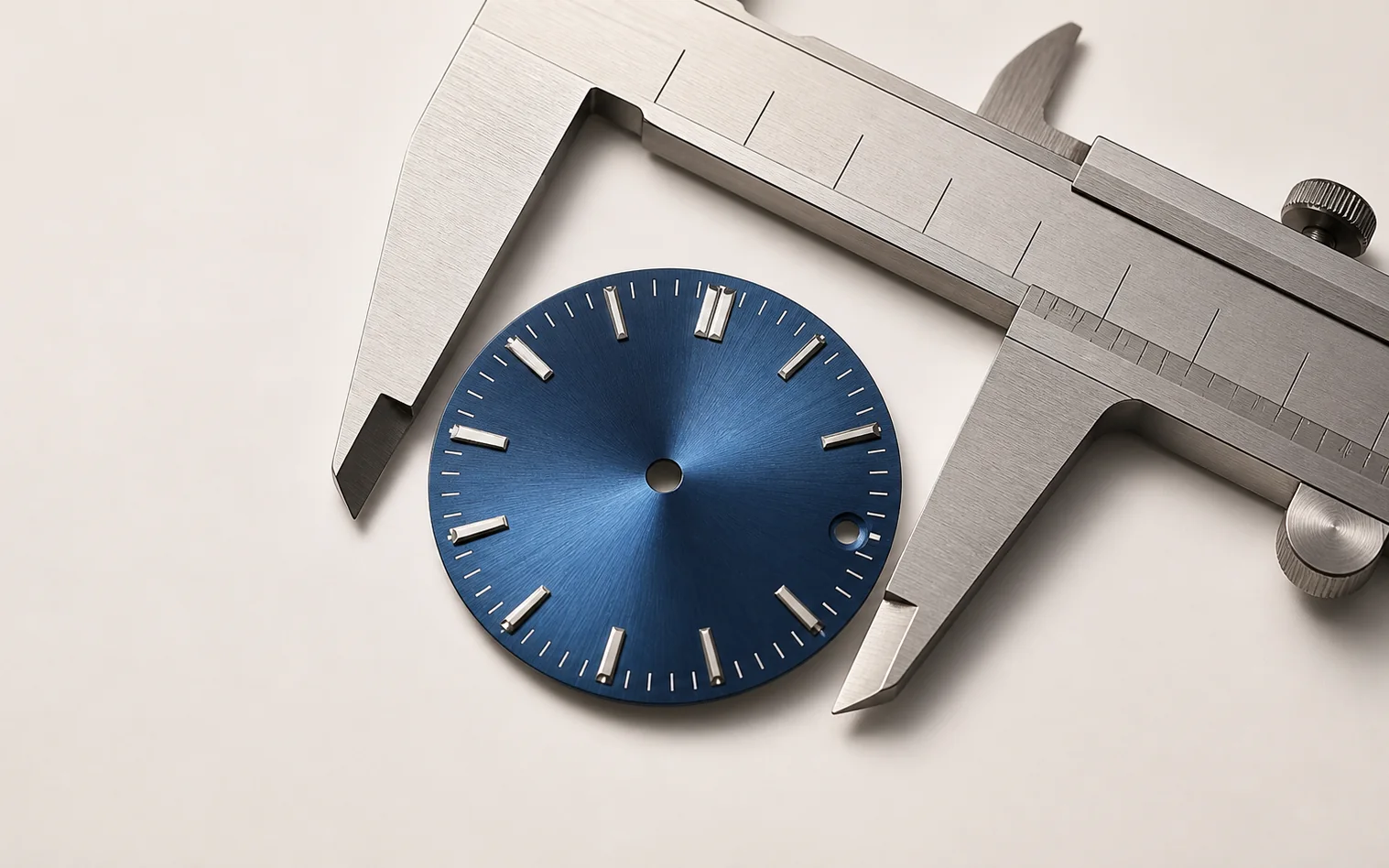
Diameter is a basic dial measurement, but it does not describe every interface that determines whether the dial can be fitted to a particular movement and case.
What “28.5 mm” means
It normally describes the dial's outer diameter. It does not automatically mean that the dial fits every case or works with any similarly sized movement.
Diameter is not compatibility
The dial must also match the calibre, dial-foot arrangement, centre hole and complications. Date or day windows must correspond with the movement's calendar layout.
- Movement and calibre
- Dial feet and arrangement
- Centre hole
- Windows and complications
- Space supported by the case
Technical example: NH35
The NH35 manufacturer profile provides a clear example of several measurements that must be considered together.
- Outer dial diameter
- 28.5 mm Manufacturer data · TMI
- Approximate centre hole
- 2.05 mm Manufacturer data · TMI
- Layout
- Date Manufacturer data · TMI
Differences that change the build
NH34 needs room for a central GMT hand and its drawing shows an approximate 2.88 mm centre hole. NH36 uses a day-date layout, while NH38 requires an open-heart dial.
A shared outer diameter does not prove that dial centres, feet or windows are interchangeable.
- NH34
- GMT + date Manufacturer data · TMI
- NH36
- Day + date Manufacturer data · TMI
- NH38
- Open-heart Manufacturer data · TMI
How to measure a dial
Use a caliper to measure the outer diameter without including protruding elements. Apply the jaws gently so the dial is not pressed or deformed.
Then check the centre, feet, windows and complete layout. Do not apply tolerances that are not documented.
Checklist before buying
- Outer diameter
- Calibre
- Date position or window
- Dial-foot arrangement
- Centre hole
- Case in which it will be fitted